
Emergency Garage Door Repair
Urgent help for doors frozen shut, stalled part-way, or hanging out of square.
View serviceCundles East is a residential area of cul-de-sacs and crescent streets in north Barrie, east of Bayfield Street and divided by Cundles Road East, with mostly single-detached houses among park land and mature trees. Sixty per cent of its homes date from 1961 to 1980 and 16 per cent of dwellings are semi-detached. Short curved driveways off a crescent change how a service vehicle parks and how far a door can swing clear of the apron, and both are worth flagging when a visit is booked.
Cundles East, Barrie, Ontario · L4M
1960s and 1970s detached and semi-detached houses on cul-de-sacs and crescents, 60 per cent built 1961 to 1980 with a further 20 per cent in the 1980s
Booking requests are confirmed by email after availability is checked
Cundles Road East, St. Vincent Street, Bayfield Street
Cundles East is the north-Barrie area east of Bayfield Street, divided by Cundles Road East with St. Vincent Street as its eastern border, and it is described as a residential area of many cul-de-sacs and crescent streets with mostly single-detached homes among park land and mature trees. Sixty per cent of its houses were built between 1961 and 1980 and a further 20 per cent in the 1980s. Single-detached houses account for 60 per cent of dwellings, semi-detached 16 per cent and duplexes 11 per cent.
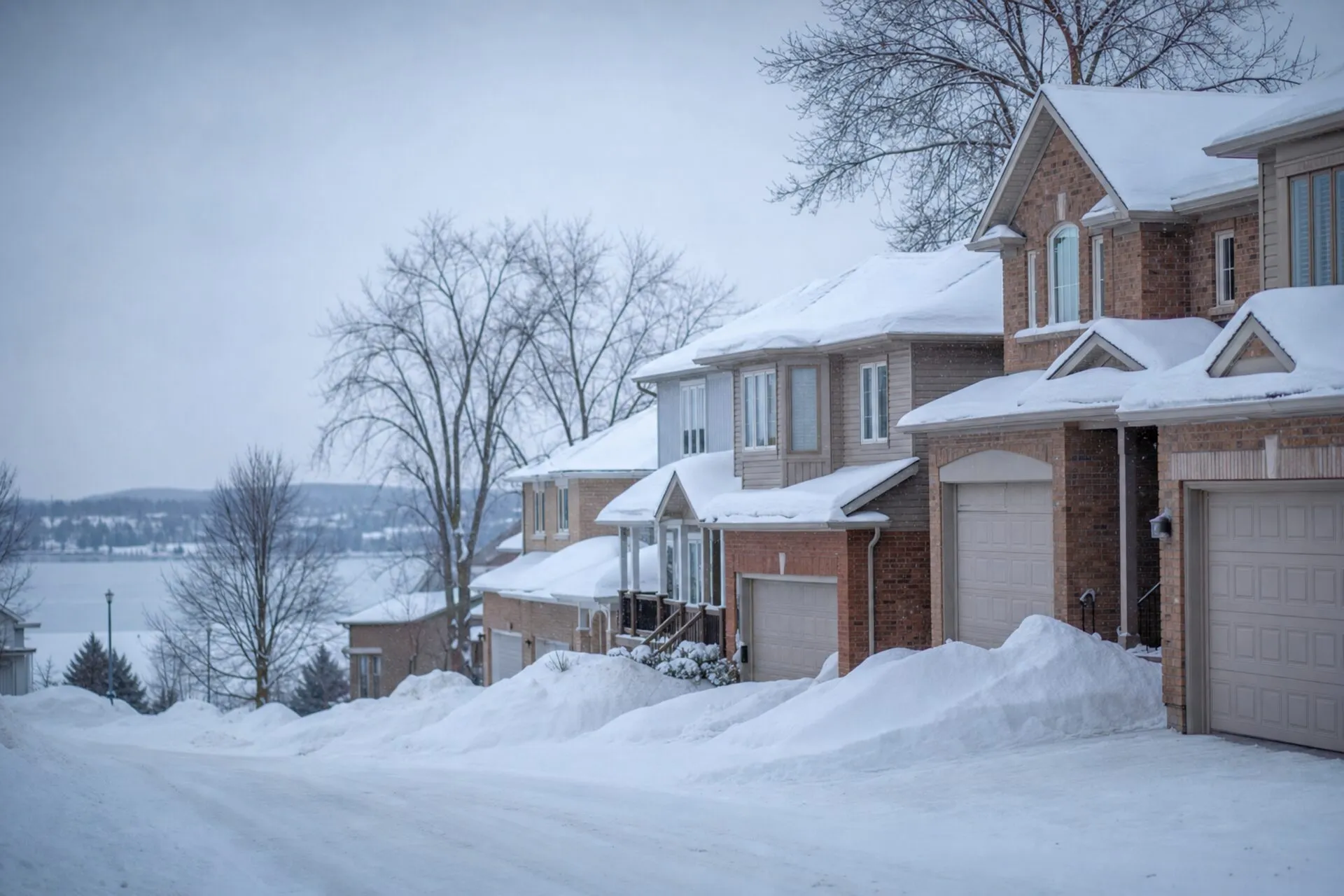
The street layout has a direct bearing on garage work. Crescents and cul-de-sacs produce pie-shaped lots, curved driveways and garages set at an angle to the road rather than square to it, which changes both where a service vehicle can stand and how far a door swings clear of the apron. In a snowbelt winter it changes something else too: a cul-de-sac bulb is where the plow leaves its load, and the banks that build up in front of these driveways sit there until a thaw.
Snowbank contact is the seasonal problem on these streets. Packed snow pushed against the outside face of a door loads the bottom sections in a direction they were never designed to take, and a hard bank behind a door that is opening puts a sideways force through the rollers and into the vertical track. The visible result is a dented bottom section, a bent track flange or a roller that has jumped its rail. Doors of 1960s and 1970s vintage also carry single-width openings and lighter track than current product, so a rail that has been knocked once tends to be checked along its full length rather than at the obvious dent.
Plow banks at the head of a cul-de-sac press against door faces and rails, which makes track, roller and section work the recurring winter job on this 1960s and 1970s stock.
References: HoodQ: Cundles East neighbourhood profile · Wikipedia: Barrie · Wikipedia: Snowbelt · Current Results: Barrie temperatures by month
Urgent help for doors frozen shut, stalled part-way, or hanging out of square.
View service
Tension, bearings and shaft hardware corrected while the springs are still intact.
View service
Broken torsion and extension springs replaced as correctly matched sets.
View service
Slack, frayed or unwound lift cables renewed and rewound square on the drums.
View service
Seized rollers renewed, snowbank-dented rails corrected, derailed doors re-railed.
View service
Fault-finding on openers that hum, stall, reverse or ignore their controls.
View service
Operators sized to the door and commissioned with a tested safety reverse.
View service
Dented, split or rust-blistered sections matched to the door already fitted.
View service
Replacement doors measured to the opening, the headroom and the side room.
View service
Balance test, hardware torque, cold-weather lubrication and a full safety check.
View serviceBook here and we'll confirm your time window by email, usually the same day.
Cundles East falls in the L4M postal group. This is the stretch of Barrie this page covers.
Map data © Google. Pin shows the service area, not a walk-in location — all work is done at your home.
A real callout, not stock imagery.
A sectional door pulled off its tracks, taken down and supported on site so it could be checked and re-hung safely — photographed on the job.