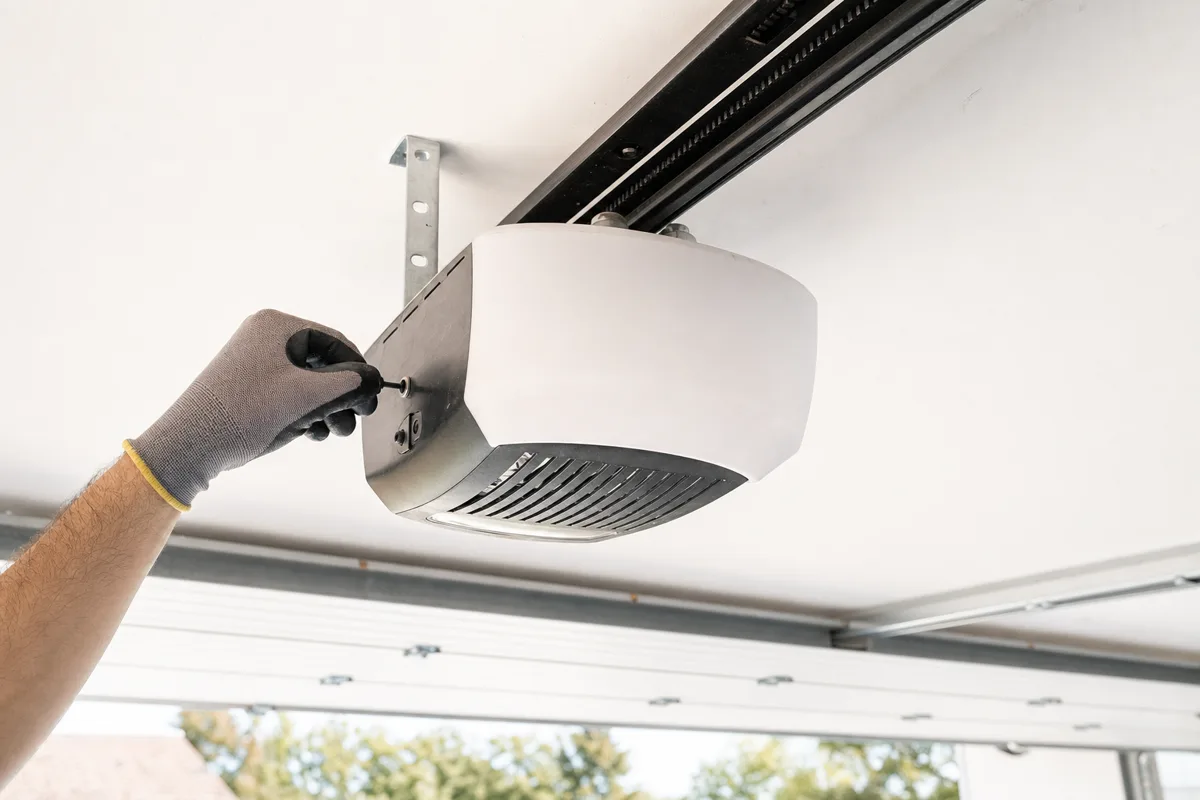

Garage Door Opener Installation
Operators sized to the door and commissioned with a tested safety reverse.
View detailsFault-finding on openers that hum, stall, reverse or ignore their controls.

An opener is a motor, a drive, a logic board, a set of limits and a pair of safety sensors. A door that will not respond is often a door with a mechanical problem the opener is correctly refusing to force, so the first question on any opener call is whether the door itself moves freely by hand. Diagnosing in that order avoids replacing a working motor that was struggling against a badly balanced door.
Openers commonly outlast the door hardware around them if the door is kept in balance, and they fail early if it is not. The honest test of whether repair is worth it is whether the failed component is a wear item on an otherwise sound unit, or a board or motor on a unit whose parts are becoming hard to source. An older opener without modern safety reversal features is worth replacing on those grounds alone.
Work through the symptom first — some of these turn out to need no technician at all.
Chain, belt and screw drives all wear, and the plastic drive gear in many chain-drive units is a known wear point. A motor that runs without moving the door, accompanied by a grinding sound, usually means the drive is turning nothing. Repeatedly forcing an unbalanced or frozen door is the fastest way to get there.
The safety sensors either side of the opening must see each other for the door to close. A knock from a bin, a spider web, road grime, or a low sun angle can break that beam. A door that reverses immediately after starting down, with the opener light flashing, is usually a sensor problem rather than a motor problem.
Openers learn how far the door travels and how much force that should need. When a door grows heavier through the season, force settings get raised to compensate and the safety margin disappears. Once the door is fixed, those settings need to come back down or the opener will keep pushing through faults instead of stopping.
Remote batteries lose usable capacity in the cold, and keypads mounted outdoors suffer worse. Barrie's January daily mean is minus 7.7 degrees, with 116 days a year below minus 2, so an intermittent opener that behaves in September and misbehaves in January frequently comes down to battery voltage or a moisture-affected connection.
Cold puts openers under a load they never see in summer. A bottom seal frozen to the slab means the first lift of the day asks the operator to break an ice bond before it starts lifting a door, which is exactly how arms bend and trolleys strip. With 67 days a year that never rise above freezing and snow cover normally lying from late November through February, Barrie openers get many chances to be asked to do that.
The photo-eyes and the automatic reversal are safety devices, not conveniences, and an opener with its force turned up to push through a sticking door has had its protection quietly removed. Never disable or bypass a sensor to get a door to close. Work inside the motor head means unplugging the unit first, and the capacitor can hold charge after disconnection.
The opener is disconnected and the door is lifted manually. If it is heavy, binds or will not hold at waist height, the door is the fault and the opener was the symptom. That check comes before any part is condemned.
Photo-eye alignment and lenses, wall control, wiring at the terminals, remote batteries and programming, and any keypad are all checked in order. Many opener calls end here, with an alignment or a battery rather than a component failure.
The trolley, drive gear, chain or belt tension, rail condition, capacitor and logic board are examined and any diagnostic codes read. What is actually failed is identified before parts are discussed, and whether repair or replacement makes better sense is set out plainly.
After repair, travel limits and force settings are reset against a properly balanced door, and both safety systems are tested: the photo-eye reversal and the contact reversal on an obstruction. Nothing is signed off until the door reverses as it should.
Operators sized to the door and commissioned with a tested safety reverse.
View details
Seized rollers renewed, snowbank-dented rails corrected, derailed doors re-railed.
View details
Balance test, hardware torque, cold-weather lubrication and a full safety check.
View detailsFill out the form and we'll confirm your appointment by email.
Garage Door Opener Repair is available across every Barrie neighbourhood inside the area below.
Map data © Google. Pin shows the service area, not a walk-in location — all work is done at your home.

A real callout, not stock imagery.
A sectional door pulled off its tracks, taken down and supported on site so it could be checked and re-hung safely — photographed on the job.