
Garage Door Spring Replacement
Broken torsion and extension springs replaced as correctly matched sets.
View detailsSlack, frayed or unwound lift cables renewed and rewound square on the drums.

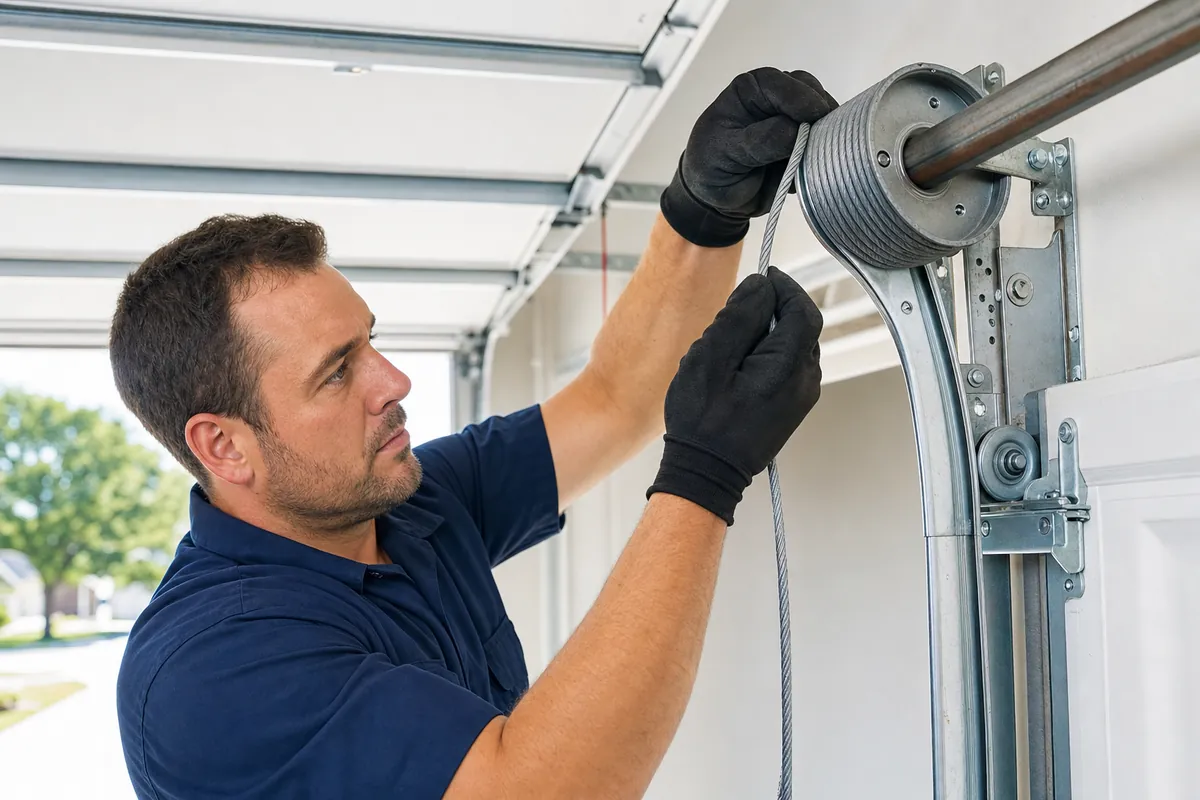
Lift cables convert spring tension into movement at the bottom of the door. They are thin, loaded on every single cycle, and positioned at floor level where salt, grit and meltwater collect. When one frays or jumps its drum the door immediately stops travelling square. A cable repair is therefore two jobs: fitting new cables, and finding out why the old one left its drum in the first place.
Cables usually outlast the first set of springs but rarely the second, and their working life depends more on environment than on age. A cable in a dry, detached garage can look almost new for a long time; the same cable in an attached garage that takes a salted vehicle in every winter night will show corrosion much sooner. Cables are replaced in pairs and are worth renewing as a matter of course whenever a spring set is changed.
Our troubleshooting guides walk the diagnostic checks in order so you can confirm the fault before booking.
The cable's hardest-working point is the loop through the bottom bracket. Repeated flexing at that tight radius, with grit and driveway moisture in the strands, breaks individual wires. Once enough have gone the survivors carry more load each and the failure accelerates.
If the door stops unevenly, catches on an obstruction, or is closed onto a ridge of ice or a bin, a cable can go slack and hop out of its grooves, then wind back in the wrong place on the next cycle. In Barrie this is the classic sequence after a door has been closed onto a frozen snowbank at the threshold.
Cables sit exactly where snowmelt, road salt and grit pool. The residue holds moisture against the strands long after the puddle has dried, and corroded steel loses strength before it looks obviously bad. Bottom brackets and the lower few centimetres of track corrode from the same source.
A loose drum set screw, a bearing with play, or a bottom bracket that has worked its fasteners changes where the cable wants to sit. It then winds unevenly and the door climbs slightly out of square on every cycle. Replacing only the cable leaves that fault free to repeat.
Cable and bottom-bracket corrosion is a Barrie signature because of how long the salt season runs. Snow cover normally forms at the end of November and lies through February, seasonal snowfall averages 223.0 centimetres, and vehicles bring salted slush into the garage day after day for months. Add ice that bonds the bottom seal to the slab, so the opener starts a lift against a stuck door, and you have the exact conditions that produce slack cables jumping their drums.
Cables are part of the counterbalance system and are under load whenever the door is not fully supported. A cable released without controlling spring tension can whip, and a door with one cable gone can twist as it moves. If a cable has failed, leave the door closed, do not run the opener, and keep hands away from the bottom brackets, which are anchored under tension.
The door is secured so it cannot drop while the cable system is opened up, and spring tension is let down under control where the work requires it. Nothing at the bottom bracket is disturbed while the door still depends on it.
Both cables, both drums, the shaft, the bearings, the rollers and the lower track are examined. A frayed cable on one side is regularly downstream of a seized roller or a bent rail on that side, and the origin has to be found for the repair to hold.
Cables are replaced as a pair in the correct length and rating for the door's drop, then seated so both drums wind identically. Drum set screws are torqued, the shaft is checked for end play, and corroded bottom fixtures are dealt with while access is open.
The door is cycled by hand and checked for even contact with the slab, equal cable tension and rollers tracking cleanly through the curve. Opener force and limits are rechecked afterwards, because a door that was binding will have had its force settings raised to compensate.
Broken torsion and extension springs replaced as correctly matched sets.
View details
Seized rollers renewed, snowbank-dented rails corrected, derailed doors re-railed.
View details
Urgent help for doors frozen shut, stalled part-way, or hanging out of square.
View detailsFill out the form and we'll confirm your appointment by email.
Garage Door Cable Repair is available across every Barrie neighbourhood inside the area below.
Map data © Google. Pin shows the service area, not a walk-in location — all work is done at your home.
A real callout, not stock imagery.
A sectional door pulled off its tracks, taken down and supported on site so it could be checked and re-hung safely — photographed on the job.