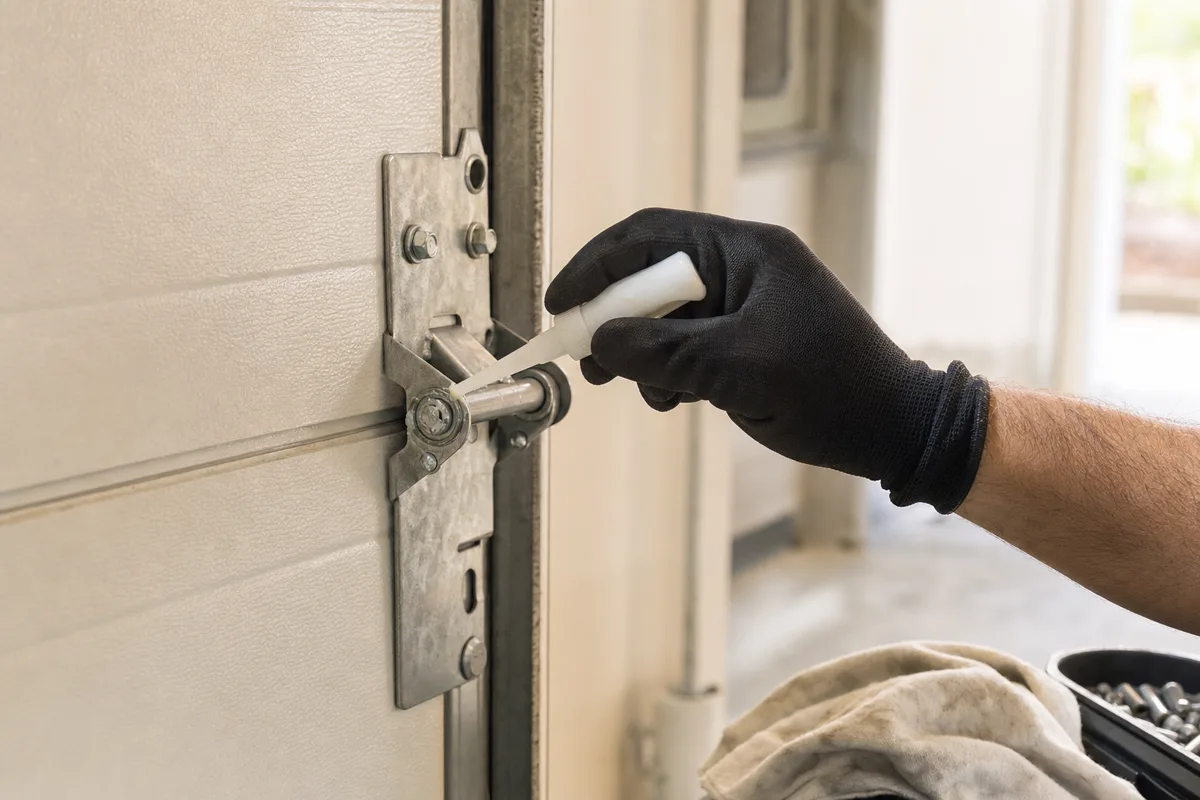

Garage Door Roller & Track Repair
Seized rollers renewed, snowbank-dented rails corrected, derailed doors re-railed.
View serviceDifferent noises mean different things. Grinding, squealing and rattling are maintenance; a single loud bang is a failure. Learn to tell them apart before you cycle the door again.
Grinding or rumbling that follows the door through its travel is almost always worn rollers, and it is the cheapest thing on the door to fix. Squealing is dry hinges and bearings, usually with lubricant that has thickened or washed out. Rattling is loose fasteners. A knock at the same point every cycle is a track fault or a flat-spotted roller. A single loud bang is a broken spring or a snapped cable, and in that case stop using the door, park outside and book a repair without cycling it again.
A garage door is the largest moving object in most houses, so some sound is normal. What matters is the character of the noise, whether it is constant or happens at one point in the travel, and whether it appeared gradually or all at once. Gradual noise is nearly always wear in the rollers, hinges and bearings, and it responds to servicing. Sudden noise is a different category. A single sharp bang from the garage, especially overnight or on a cold morning, is the classic sound of a torsion spring fracturing, and the correct response is to stop using the door rather than to investigate the sound by pressing the button again. Between those two extremes sit the intermittent noises: a knock at a consistent height, a scrape that follows the door up the track, a rattle that only appears in a squall. Each has a short list of likely causes, and in Barrie cold weather changes the list.
Start at the top. The early checks are the most common causes and need no tools.
Think back to whether the noise arrived gradually over months or appeared as one event. A single sharp report, often heard from inside the house at night, means something released under tension. Look above the opening for a visible gap in a spring coil, and look for a cable hanging slack beside a track. If either is present, stop here and do not run the opener.
What it means: A gap in a spring coil or a slack cable means the door is unsafe to cycle and needs a technician.
With the door in full view, run one cycle and note whether the noise is continuous or occurs at a specific height. Continuous grinding through the whole travel points at the rollers. A knock or a scrape at the same point every time points at a dent, a bend or a bracket at that height. A change in sound as the door enters the curve points at track alignment.
What it means: A fault at one consistent point in the travel is a track or bracket problem rather than general wear.
With the door fully closed and the opener disconnected, try turning each roller with a finger. A good roller turns freely and quietly. A worn one is stiff, gritty, wobbles on its stem, or has a flat worn onto the wheel. Check the stems for play in their hinges at the same time, and look for dark metal dust along the track where a roller has been dragging.
What it means: Rollers that will not turn freely are the most likely source of grinding and the first thing worth renewing.
Look over the hinges, roller brackets, track bolts and the opener mounting for anything visibly loose, and look for hinges that have worn oval around their pins. Then check the lower half-metre of track for dents from a shovel, a snowblower chute or a bumper, and clear out any packed grit, leaf litter and old grease from the channel.
What it means: Rattling with no other symptom is usually loose hardware and is straightforward to correct.
With the opener still disconnected, lift the door by hand and release it at waist height. If the door is heavy or does not hold, the counterbalance is out and the opener has been straining, which produces its own noise. Reconnect and listen to the motor head separately: grinding from the unit with the door not moving is a stripped drive gear.
What it means: A heavy door means the noise is a symptom of balance, not of the part that is making the sound.
Do not attempt to lubricate, adjust or inspect anything if you have found a gap in a spring coil, a slack or frayed cable, or a roller out of its rail. Never spray lubricant onto a spring while the door is under tension and never put a tool near a winding cone. Do not run the opener to reproduce a bang. If the door is heavy to lift by hand, leave it closed and park outside rather than continuing to use it, because the operator is carrying a load it was not built for.
Cold changes the noise. Barrie records 157 days a year on which the temperature falls to zero or below and 67 that never rise above freezing, and old lubricant in the bearings thickens in those conditions, so a door that was merely loud in October can squeal and drag in January. Winter also supplies the abrasives: road grit and salt residue tracked in on a vehicle collect in the lower channel and set into a paste. And the coldest mornings are when marginal springs let go, which is why the sudden bang is a January sound in this city.
Fill out the form and we'll confirm your appointment by email.
These guides are written for Barrie homes. If the fix is beyond a homeowner check, we work everywhere inside this area.
Map data © Google. Pin shows the service area, not a walk-in location — all work is done at your home.

A real callout, not stock imagery.
A sectional door pulled off its tracks, taken down and supported on site so it could be checked and re-hung safely — photographed on the job.
