
Emergency Garage Door Repair
Urgent help for doors frozen shut, stalled part-way, or hanging out of square.
View serviceA frozen door is a Barrie regular, not a breakdown. The damage almost always comes from what people do next, which is to keep pressing the button.
Do not keep pressing the button. Pull the release cord with the door fully closed so the opener cannot force it, then break the ice bond mechanically and with warm, not boiling, water: clear the snow away from the threshold, work along the seal line, and use a plastic tool rather than metal. Once the door moves, dry the seal and the slab as well as you can, and keep the threshold line clear thereafter. A bottom seal that has gone hard is the underlying cause and is worth replacing before the next freeze.
Barrie is a genuine snowbelt city, and a door frozen to the slab is one of the most common winter calls in this climate. The mechanism is simple. Meltwater runs down a driveway toward the garage, or snow blows in under the door, and it refreezes at the threshold overnight. The bottom seal, which has usually hardened with age, becomes bonded into that ice. The next morning the opener is not asked to lift a door; it is asked to break an ice bond first and then lift a door. Openers are not designed for that. What follows is a bent operator arm, a stripped trolley, a cracked top section, a cable that goes slack and jumps its drum, or all four. Getting a frozen door open is mostly a matter of patience and warm water, and getting it to stop happening is a matter of seals and drainage.
Start at the top. The early checks are the most common causes and need no tools.
Press the button once, at most. If the door strains, groans, or lifts at one corner while the other stays down, stop. Pull the release cord with the door fully closed so the operator is disconnected and cannot be triggered by a remote while you work. Every extra attempt is load going through the arm, the trolley and the top section.
What it means: A door that lifts at one corner only is bonded to the slab and must not be driven any further.
Shovel the snow back from the full width of the door and a good arm's length out from it, so meltwater has somewhere to go rather than pooling at the seal. Look for a raised ridge of refrozen ice along the threshold, which is the actual bond, and note whether the ice extends under the seal or only sits against it.
What it means: A visible ice ridge along the seal line confirms the door is frozen down rather than mechanically stuck.
Pour warm water, not boiling, along the seal line and let it work, then use a plastic scraper or a wooden edge to free the seal. Avoid metal tools, which tear the rubber and score the slab, and avoid salt directly against the seal and the bottom section, because it accelerates corrosion of the panel and the bottom brackets. Repeat rather than forcing.
What it means: The door coming free after warm water confirms an ice bond and rules out a mechanical fault.
With the opener still disconnected, lift the door by hand. It should feel manageable and hold at waist height. Watch both bottom corners rise together and listen for a snap or a scrape. If one corner lags, or there is a bang as it releases, look at the cables and the bottom brackets before doing anything else.
What it means: A door that lifts evenly by hand and holds position has come through the freeze without damage.
Wipe the seal and the slab as dry as you can before closing, and clear the lower track channel of packed snow and grit. Then examine the bottom seal: if it has gone hard, flattened, split or no longer sits evenly against the concrete, it is the reason water is getting under the door and it will freeze again on the next cold night.
What it means: A hardened or split bottom seal is the underlying cause and is a straightforward replacement.
Never use an open flame, a heat gun or a propane torch on a frozen garage door. Never use boiling water, which can crack cold concrete and deform the seal. Do not drive the opener repeatedly against a frozen door, and do not pull the release cord while the door is part-open, which drops an unbalanced door onto whoever is holding it. If a cable has gone slack or a corner has dropped after a freeze, leave the door alone and book a repair rather than continuing to cycle it.
This is the most Barrie-specific problem on the site. The city lies in the Georgian Bay and Lake Huron snowbelt, with squalls running from November into January, and it receives 223.0 centimetres of snow in a normal season against 121.5 in Toronto. January alone brings 65.9 centimetres. Snow cover normally establishes at the end of November and lies through February, and 67 days a year never rise above freezing. On the slopes falling toward Kempenfelt Bay, meltwater runs toward garage openings and then refreezes, which is the whole mechanism in one sentence.
Fill out the form and we'll confirm your appointment by email.
These guides are written for Barrie homes. If the fix is beyond a homeowner check, we work everywhere inside this area.
Map data © Google. Pin shows the service area, not a walk-in location — all work is done at your home.
A real callout, not stock imagery.
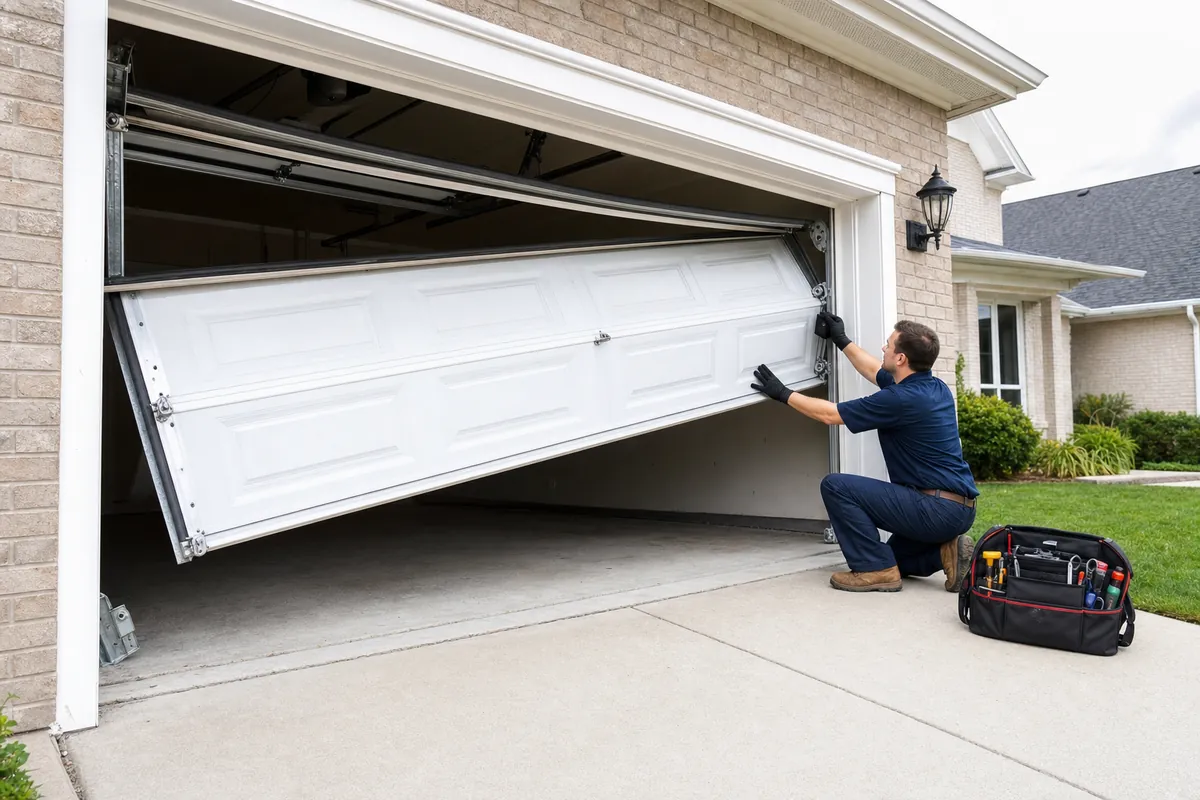
A sectional door pulled off its tracks, taken down and supported on site so it could be checked and re-hung safely — photographed on the job.
