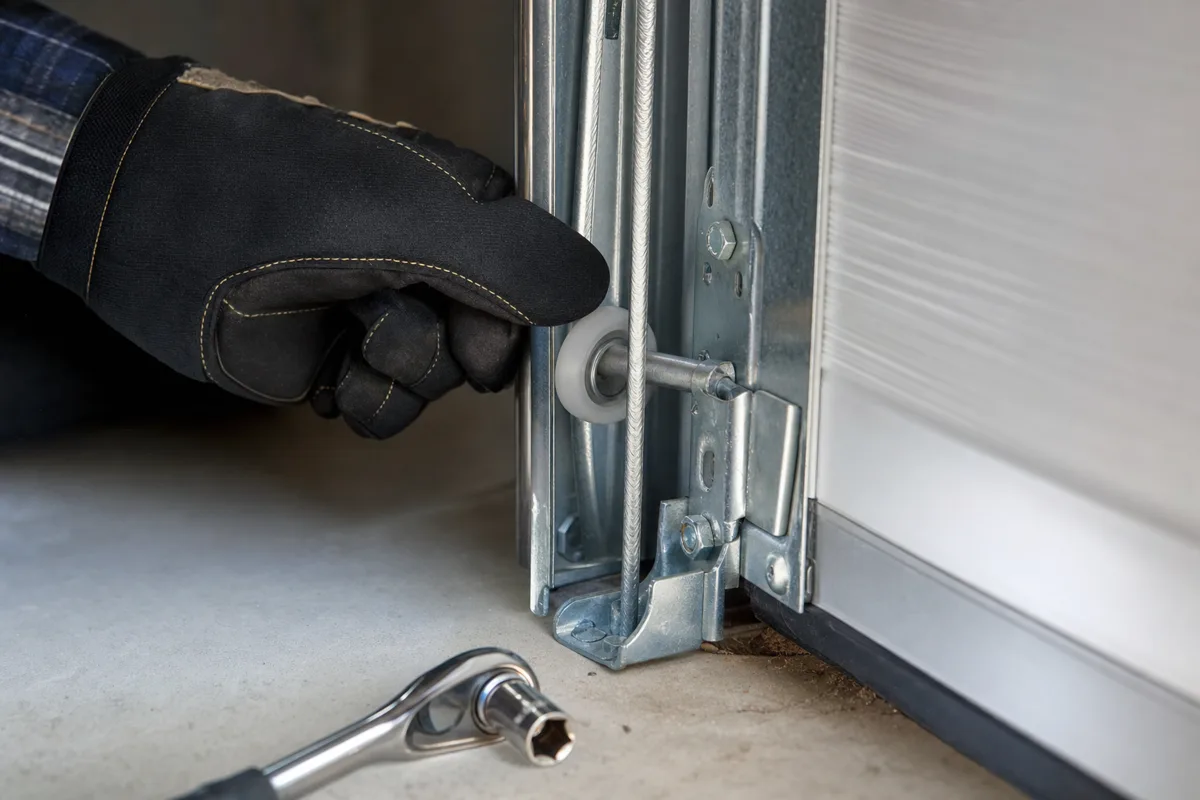

Garage Door Roller & Track Repair
Seized rollers renewed, snowbank-dented rails corrected, derailed doors re-railed.
View serviceA door out of its rail is carrying an unbalanced load overhead. Stop using it, keep clear of the opening, and do not try to lever it back.
Stop using the door and disconnect the opener if you can do it with the door closed. Do not attempt to lever a roller back into its rail, do not loosen any track bolts, and keep everyone out from under the door. A door off track is almost always downstream of something else: a cable that jumped its drum after the door was closed onto ice, an impact to the lower track, a broken spring, or a seized roller. That upstream cause has to be found and corrected or the door will simply come off again.
A garage door off track is one of the few faults on this site where the honest advice is to do almost nothing. When a roller leaves its rail, the door's weight stops being distributed the way the springs and cables were set up to distribute it. The door twists, one cable often goes slack while the other takes more load, and the assembly overhead is no longer predictable. Levering it back with a screwdriver, or running the opener to see whether it will right itself, are the two things that turn a repair into an injury or a written-off door. What you can safely do is recognise the fault, work out roughly what caused it, keep people and vehicles clear, and describe it accurately when you book. In Barrie the cause is usually one of three winter events.
Start at the top. The early checks are the most common causes and need no tools.
Stand back and look at the door as a whole. A door off track sits crooked, leans out of its opening, has a visible gap between a section and the rail, or has one roller clearly outside its guide. There may be a bulge or a kink in the track itself. Do not approach the door to test it by hand while it is in that state.
What it means: A roller outside its rail or a door leaning out of the opening confirms an off-track door and an urgent repair.
If the door happens to be fully closed and resting on the slab, pull the release cord to disconnect the operator so nobody can trigger it with a remote. If the door is part-open or leaning, leave the cord alone: releasing it can drop an unbalanced door. Then remove the remotes from the cars if there is any risk of someone pressing one.
What it means: A closed, disconnected door with the remotes out of reach is the safest state to wait in.
From a safe distance, check three things: whether a cable is hanging slack or bunched on its drum, whether a spring above the opening has a visible gap in its coil, and whether the lower half-metre of track is dented from a shovel, a snowblower or a bumper. Any of those explains why the door left the rail.
What it means: A slack cable, a broken spring or a dented lower track identifies the cause that must be fixed alongside the track itself.
Look along the bottom of the opening for a ridge of refrozen ice, packed snow, or an object the door may have been closed onto. This is by far the most common Barrie trigger: the door lands unevenly on the obstruction, a cable goes slack and hops its drum, and the next cycle pulls the door out of square.
What it means: Ice or an object at the threshold usually explains the whole sequence and is worth reporting when you book.
Keep children, pets and vehicles out of the garage and out from under the door. Photograph the door from a few metres back, the roller that has left the rail, the cables at both drums and the springs above the opening. Note whether a vehicle is trapped inside and whether the garage is standing open to the weather.
What it means: Clear photographs and an accurate description let the right parts and the right approach be planned before arrival.
Do not lever, pry or hammer a roller back into its rail, and do not loosen track bolts to make room. The vertical track brackets carry counterbalance load through the cables, and the springs above the opening hold a great deal of stored energy. Do not run the opener to try to reseat the door, do not prop the door and work underneath it, and do not pull the release cord while the door is part-open or leaning. Keep out from under the door until it has been secured by someone with the right equipment.
Three Barrie conditions produce off-track doors. First, ice at the threshold: meltwater refreezing under a hardened bottom seal, on streets that fall toward Kempenfelt Bay, stops the door short and starts the cable off its drum. Second, snow clearing: with 223.0 centimetres of seasonal snowfall and 65.9 centimetres in January alone, shovels and snowblower chutes work against the bottom half-metre of track for months. Third, storm damage, including the ice storms of March 2016 and March 2025, the latter damaging roughly 12,000 street trees.
Fill out the form and we'll confirm your appointment by email.
These guides are written for Barrie homes. If the fix is beyond a homeowner check, we work everywhere inside this area.
Map data © Google. Pin shows the service area, not a walk-in location — all work is done at your home.

A real callout, not stock imagery.
A sectional door pulled off its tracks, taken down and supported on site so it could be checked and re-hung safely — photographed on the job.