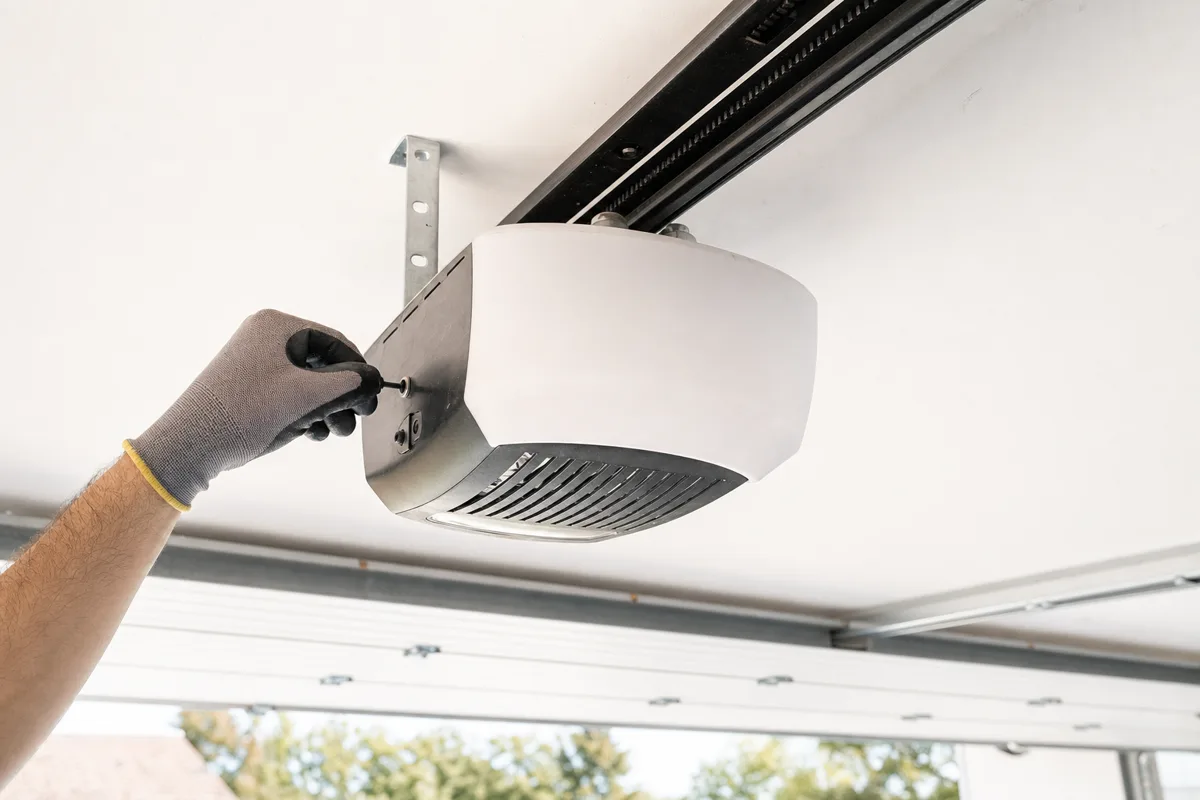

Garage Door Opener Repair
Fault-finding on openers that hum, stall, reverse or ignore their controls.
View serviceA door that reverses partway down is usually reporting something rather than breaking. Work through the checks in order, and stop the moment the door tilts, drags or needs force.
Two causes dominate. In winter it is the threshold: ice, packed snow or a ridge of refrozen meltwater under the bottom seal, which the opener correctly reads as an obstruction. Year round it is the photo-eye pair, through a blocked beam, a dirty lens, a knocked bracket or low sun striking the receiver. Clear the threshold line, wipe both lenses dry, and compare the indicator lights with the opener's normal state. If the door still reverses, drags, shakes or comes down unevenly, stop testing, because resistance in the track, rollers, cables or springs needs a technician rather than another button press.
The instinct with a door that will not close is to keep pressing the button. That is the one thing worth avoiding, because each attempt either repeats a harmless sensor fault or drives the door further into a mechanical one. Stand clear of the opening where you can see the whole door and watch a single attempt from start to finish. Note exactly where it stops or reverses, and whether the travel up to that point looked level and smooth. Keep vehicles, children and pets out of the doorway while you test. If holding the wall button is the only way to get the door down, treat that as a diagnostic result rather than a fix: openers fall back on hold-to-run closing when they cannot confirm the safety beam. In Barrie there is one extra suspect to keep at the front of your mind through winter, and it is not electronic at all. A ridge of refrozen meltwater or packed snow along the threshold will stop a door short, and the opener is behaving correctly when it reverses off it.
Start at the top. The early checks are the most common causes and need no tools.
Move bins, tools, mats and equipment away from the opening, then look along the entire line where the bottom seal meets the concrete, including both corners where debris and snow collect. In winter, chip out any raised ice ridge and sweep the packed snow clear rather than closing onto it. Then run one attempt from a safe position and note whether the door stops at the same height.
What it means: A clean close after clearing the floor means the obstruction was at the threshold, not in the opener.
The two sensors sit low on the vertical tracks, roughly a hand's width above the floor, which in a Barrie winter puts them directly in the line of salt film and driveway spray. Wipe each lens with a clean dry cloth, then check whether either bracket has been bumped or twisted. Look for cobwebs, leaves or an extension cord crossing the beam line.
What it means: A flickering or abnormal sensor indicator light almost always identifies an alignment or beam fault.
If the fault only appears in bright daylight, hold a piece of card beside the receiving sensor to shade it, without covering the doorway or touching the lens. Run one attempt and watch whether the receiver's light steadies while shaded. Low winter sun is the version of this that catches people out, because the angle is lowest exactly when the snow is brightest. Never tape anything over a lens.
What it means: A steady light and a successful close while shaded points to glare disrupting the receiver.
With the whole door in view, press the wired wall button for a single cycle. Check whether a lock or vacation setting is engaged, since that can disable remotes while leaving the wall control working. Note carefully whether the door descends only while you keep the button held down.
What it means: Hold-to-run closing means the safety circuit is not being confirmed and needs attention.
With the door fully down, sight along both vertical tracks for a bent rail, a roller sitting outside its guide, or a cable that has gone slack. During one further attempt, listen for scraping, a hard knock or an abrupt stop, and watch whether one side lags the other. A door that has been closed onto ice is the usual reason a cable has jumped its drum.
What it means: Slack cable, tilted travel or a binding noise calls for mechanical repair before any further operation.
Stop testing immediately if the door hangs to one side, drags in a track, makes a sharp mechanical noise, or has a visibly loose cable. Do not turn up the opener's closing force, do not loosen track bolts, and do not push the door down by hand. Springs, cables and bottom brackets carry the door's full weight and hold stored energy, and forcing a door in that condition is how people get hurt. If the door can be left closed safely, keep the garage clear and request an inspection through the booking form.
Barrie's climate puts the threshold at the top of this list for a good part of the year. Snow cover normally establishes at the end of November and lies through February, seasonal snowfall averages 223.0 centimetres against 121.5 in Toronto, and 65.9 centimetres of that falls in January alone. On the streets that slope down toward Kempenfelt Bay, where the land drops from 427 metres to 175 metres at the shore, meltwater runs toward garages and refreezes overnight at the opening. The pattern to look for is a door that closes normally in the afternoon and refuses at seven in the morning: that is ice, not electronics.
Fill out the form and we'll confirm your appointment by email.
These guides are written for Barrie homes. If the fix is beyond a homeowner check, we work everywhere inside this area.
Map data © Google. Pin shows the service area, not a walk-in location — all work is done at your home.

A real callout, not stock imagery.
A sectional door pulled off its tracks, taken down and supported on site so it could be checked and re-hung safely — photographed on the job.
