
Garage Door Spring Replacement
Broken torsion and extension springs replaced as correctly matched sets.
View serviceA broken spring is the most common serious garage door failure, and it is easy to confirm from a safe distance. The important part is what you do next.
The definitive sign is a visible gap in the coil of a spring above the door, typically a couple of centimetres of daylight where the coil should be continuous. The supporting signs are a loud bang heard earlier, an opener that hums or lifts the door only a few centimetres, a door far too heavy to lift by hand, a door that slams down rather than descending under control, and a bent top section where the operator has tried to lift a dead weight. If you see any of these, stop using the opener, park outside, and book the repair.
Torsion springs sit on a shaft above the opening and carry essentially the whole weight of the door. The opener only guides a door that the springs have already made nearly weightless. When a spring fractures, that balance disappears instantly, and everything downstream behaves differently: the door becomes very heavy, the opener struggles or refuses, cables can go slack, and the door may sit crooked. All of the signs are visible without touching anything, which matters, because spring work is the one job on a garage door that genuinely should not be attempted by a homeowner. In Barrie the calendar is part of the diagnosis. Springs are rated in cycles and fail from accumulated fatigue, but the moment they choose is usually a very cold one, and this city supplies plenty of those.
Start at the top. The early checks are the most common causes and need no tools.
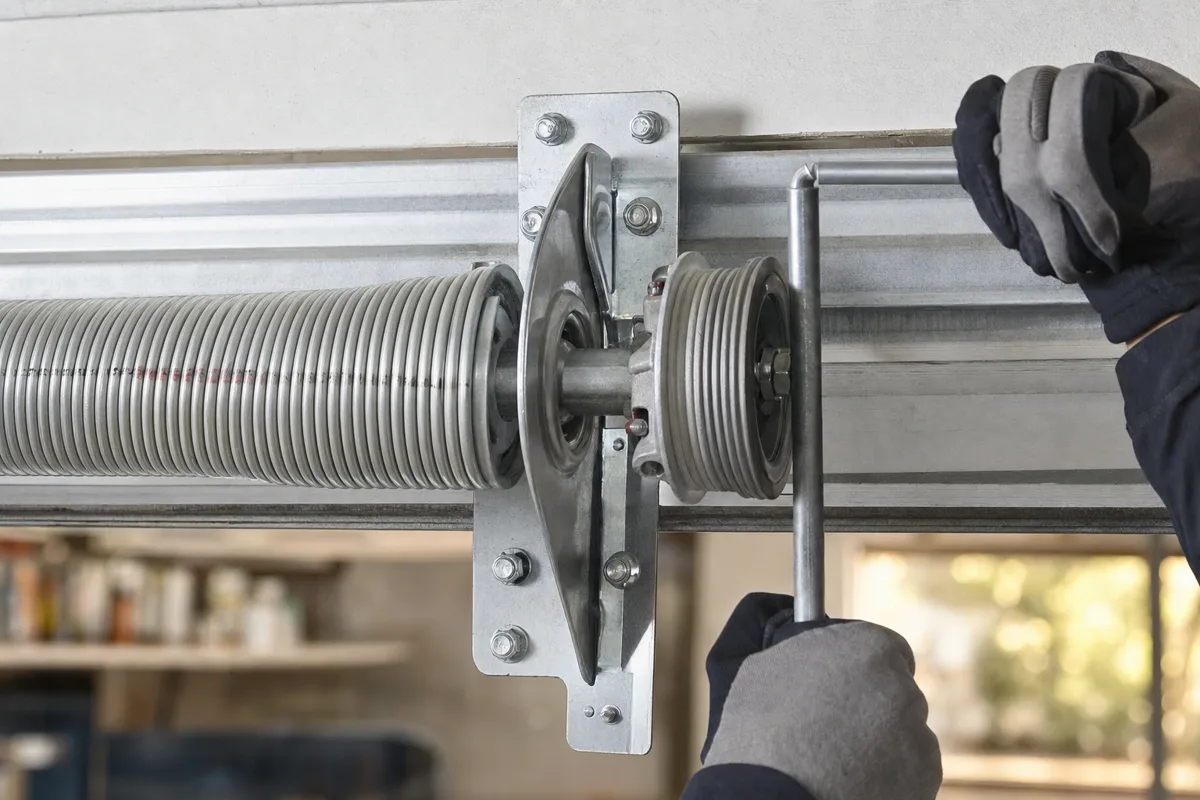
Stand back from the opening with a flashlight and look at the shaft above the door. A sound torsion spring is a continuous coil. A broken one shows a clear gap, usually one to a few centimetres wide, where the two ends have separated and unwound slightly. Do not climb up to it, do not touch it, and do not put a tool anywhere near the winding cones.
What it means: A visible gap in a coil is conclusive: the spring has broken and needs replacement.
Press the button once and watch. An opener facing a broken spring typically hums, strains, lifts the door a few centimetres and stops, or trips its own overload and reverses. Listen for grinding from the motor head, which means the drive is now being damaged. One attempt is enough; repeated attempts turn a spring job into a spring-and-opener job.
What it means: An opener that strains and stops after a few centimetres is behaving exactly as a broken spring makes it behave.
Only attempt this with the door fully closed. Pull the release cord to disconnect the opener, then try to lift the door a small distance with both hands and your back straight. A balanced double door feels manageable. A door with a broken spring feels immovable, and if it moves it will want to fall back. If it feels heavy, set it down and stop.
What it means: A door that cannot be lifted comfortably by hand has lost its counterbalance and is not safe to operate.
Look for a cable hanging loose beside a track or bunched on its drum, which often accompanies a spring failure. Then look at the top section of the door where the operator arm attaches, for a bend, a crease or a bracket pulling out of the panel. That damage is caused by an opener trying to lift an unbalanced door and is a reason to stop immediately.
What it means: Slack cables or a distorted top section mean the failure has already begun to damage other parts.
Leave the door closed, keep children and pets out of the garage, and move any vehicle you can. Then photograph the springs above the opening and the door from a few metres back, and note whether the door is a single or a double and roughly when the house was built. Those details determine which springs the technician brings.
What it means: Good photographs and a door width often mean the correct spring set arrives on the first visit.
A wound torsion spring stores a very large amount of energy in a small space, and it is released with purpose-made winding bars by someone trained to use them. Loosening a winding cone with a screwdriver is the classic cause of serious garage-door injury. Do not run the opener with a broken spring, do not try to prop the door open with timber and work underneath it, and do not pull the release cord while the door is part-open, because that hands the whole weight of an unbalanced door to whoever is holding it.
Barrie's cold is why springs break here when they do. The January daily mean is minus 7.7 degrees with a mean low of minus 12.4, there are 53 nights a year below minus 10 and around 12 below minus 20, and the temperature reaches the minus thirties roughly once every year or two. Spring steel is less forgiving at those temperatures, so a spring near the end of its cycle rating goes on the first hard morning. The local record shows how much a cold snap concentrates failures of any kind: in 2014, Barrie watermain breaks jumped from an average of about eleven a year to 34.
Fill out the form and we'll confirm your appointment by email.
These guides are written for Barrie homes. If the fix is beyond a homeowner check, we work everywhere inside this area.
Map data © Google. Pin shows the service area, not a walk-in location — all work is done at your home.

A real callout, not stock imagery.
A sectional door pulled off its tracks, taken down and supported on site so it could be checked and re-hung safely — photographed on the job.